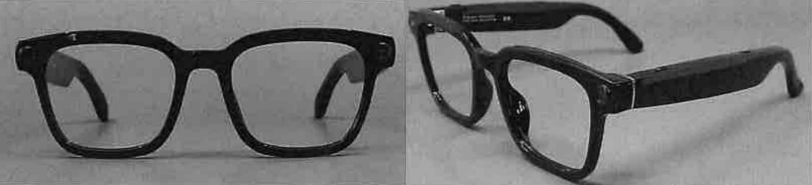
Demand is increasing for wearable smart devices that can simultaneously perform various functions such as video recording, remote communication, and information checking in both industrial sites and daily environments. In particular, in various work environments such as manufacturing, logistics, and facility management, the need for equipment that can record or share work situations in real time is growing. At the same time, demand is also expanding for convenient shooting and communication functions in everyday life. However, existing smart glasses are often designed with an electronic-device-oriented form, resulting in lower wearing comfort compared to general eyewear or an excessively mechanical appearance. This makes them difficult to wear for long periods and burdensome to use in daily environments. In addition, many products have limitations in applying prescription lenses or fail to provide usability equivalent to general glasses, which limits actual user expansion. Therefore, this item aims to develop an AI-based camera smart glasses design that can be used in both daily and industrial environments. The goal is to propose a structural design that maintains the appearance and wearing comfort of general eyewear while stably accommodating camera and Bluetooth functions. In particular, the main purpose is to derive a smart glasses design direction based on an eyewear structure that can support prescription lenses, allow long-term wear, and be used naturally in various work environments.